
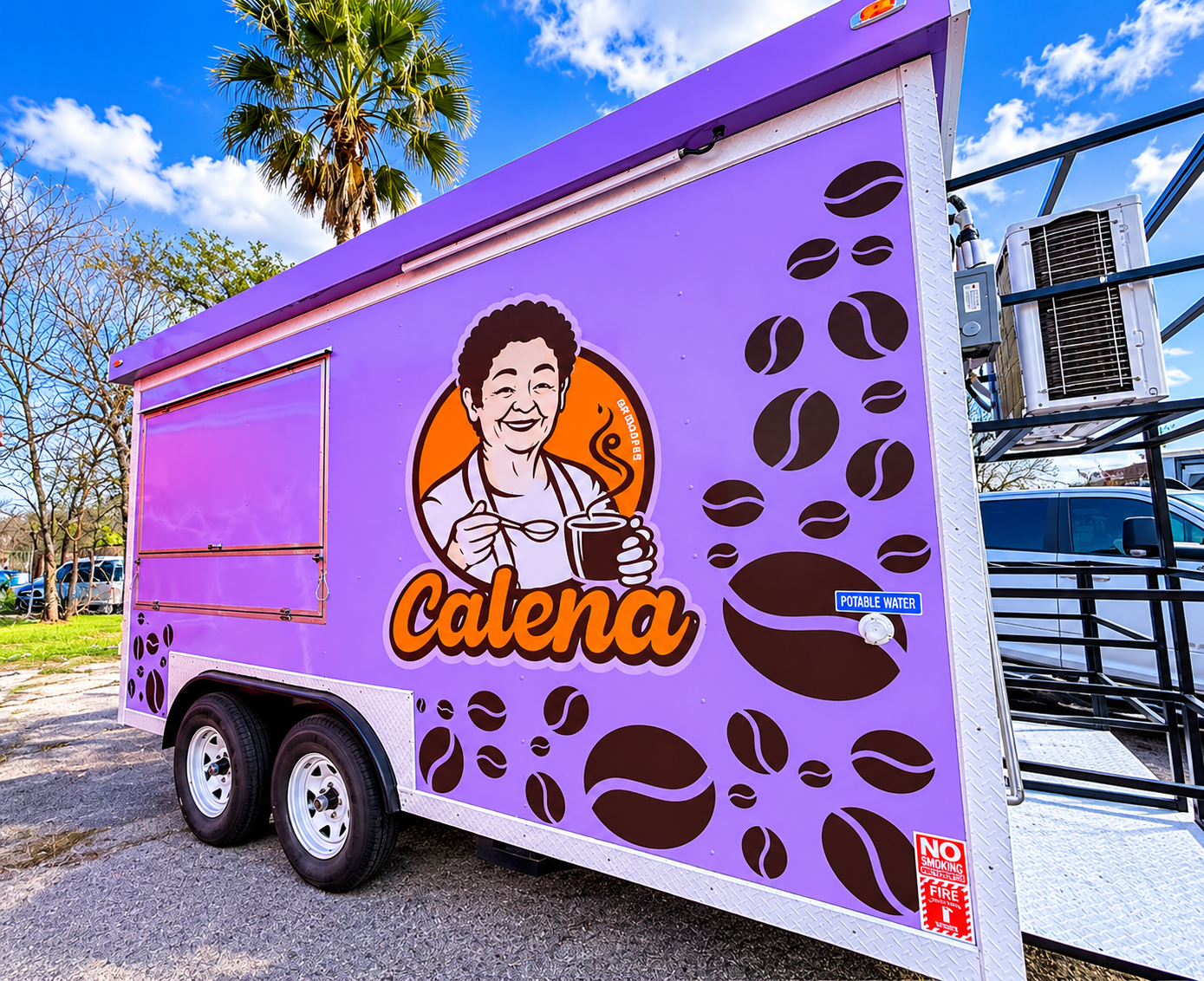
Thinking about opening a coffee trailer? We break down real startup costs, permits, monthly expenses and how much profit you can expect, so you can plan your mobile coffee business with confidence.
How Much Does It Cost to Start a Coffee Trailer?
Most coffee trailer startups in the Houston area land somewhere between $25,000 and $40,000, depending on the size of the trailer, the equipment you choose and how much branding you want. Here is where the money goes.
1. The trailer itself
This is your biggest investment. A new, custom-built coffee trailer typically runs from about $20,000 to $50,000 or more, depending on length, finishes and what comes installed. A custom build lets you design the layout around your menu instead of squeezing your workflow into a generic box.
2. Coffee equipment
Espresso machine: the heart of the business. Compact one-group commercial machines cost roughly $3,000 to $7,000, while high-volume two- or three-group machines can run $10,000 and up.
Grinder: a quality commercial burr grinder is usually $800 to $3,000. Many owners run two (regular and decaf).
Refrigeration: under-counter fridges for milk and cold brew.
Blenders and ice storage if you plan to sell frozen drinks (and in Houston, you should).
3. Power
Espresso machines use a lot of electricity. A standard two-group machine needs 220V and can draw 4,000 to 6,000 watts, so your electrical system and generator (or shore power) must be planned from the start. This is one of the most common mistakes we see in DIY builds.
4. Permits and licenses
Texas changed the rules for mobile food units in 2025–2026. Starting July 1, 2026, mobile food unit operators need a permit from the Texas Department of State Health Services (DSHS). Before that change, the City of Houston Mobile Food Unit Medallion cost $258 per year plus inspection fees. Also plan for a Texas sales tax permit, an LLC or business registration, and food handler/manager certificates. Always check the current DSHS fee schedule before you budget.
Good news: you don't have to figure this out alone. When you build your trailer with Rancho Trailers, we help you through the DSHS permit application process, so your trailer is ready to pass inspection and start selling sooner.
Sample startup budget
Item | Estimated range |
|---|---|
Custom coffee trailer | $20,000 – $50,000+ |
Espresso machine | $3,000 – $12,000 |
Grinder(s) | $800 – $3,000 |
Refrigeration & water system | $1,500 – $5,000 |
Generator / power | $800 – $3,000 |
Permits & licenses | $500 – $1,500 |
Initial inventory | $500 – $4,000 |
POS, insurance, branding | $1,500 – $5,000 |
Total | ≈ $25,000 – $40,000 |
Ranges are estimates and depend on equipment choices and your build.
Is a Coffee Trailer Profitable?
Short answer: yes, it can be very profitable — if you have the right location and keep your costs under control.
Why coffee has great margins
The ingredients in a cup of coffee are cheap compared to what customers pay. A typical drink costs around $1 to make (beans, milk, cup and lid) and sells for $4 to $6. That gives coffee a gross margin of 60% to 80% per cup, one of the best in the food business.
And because a trailer has no rent, no big build-out and low overhead, more of that margin stays in your pocket compared to a traditional coffee shop.
Don't forget spot rent and event fees
No rent doesn't mean free parking. Most owners pay for the spot where they sell: a food truck park or private lot usually runs about $500 to $1,000 per month. Events and markets charge either a flat daily fee or a percentage of your sales. A good rule of thumb is to keep event fees under about 10% of what you expect to sell that day.
A simple example
Let's run conservative numbers for a coffee trailer working weekdays near offices or a school:
Drinks sold per day | 120 |
Average ticket | $5.50 |
Daily sales | $660 |
Days open per month | 22 |
Monthly sales | ≈ $14,500 |
Cost of goods (~25%) | – $3,600 |
Other operating costs (commissary, fuel, insurance, fees, etc.) | – $2,500 |
Spot rent or event fees | – $750 |
Before labor and trailer payment | ≈ $7,650 |
This is an illustrative example, not a guarantee. Your results depend on location, pricing, hours and how you run the business.
Add weekend events, farmers markets, weddings and corporate catering, and those numbers can grow quickly. Event bookings often bring in a full day's sales in just a few hours.
What makes a coffee trailer profitable (or not)
Location. A spot near offices, hospitals, gyms or schools can sell hundreds of drinks a day; a bad one barely sells 50.
A focused menu. Fewer items means faster service, less waste and lower inventory costs.
Speed. A well-designed layout lets one barista serve more customers during the morning rush.
How Rancho Trailers Can Help
At Rancho Trailers, we build custom food and coffee trailers for entrepreneurs nationwide, from our home base in Houston to customers across the United States. Every trailer is designed around your menu and workflow, with the electrical and water systems sized correctly for commercial espresso equipment.
We also offer payment plans with weekly payments over 3 years, so you can start selling coffee and let the business help pay for the trailer.
Ready to start your coffee trailer? Visit ranchotrailers.com or contact us for a free quote.
Frequently Asked Questions
How much does a coffee trailer cost in Houston? Most complete setups land between $25,000 and $40,000, including the trailer, equipment, permits and initial inventory.
Do I need a permit to run a coffee trailer in Texas? Yes. Since July 1, 2026, mobile food units in Texas are permitted through the Texas Department of State Health Services (DSHS).
How many cups of coffee do I need to sell to break even? It depends on your monthly costs, but many trailer owners need around 80 to 150 drinks a day to cover expenses and start making a profit.